Slow Travel by Train for Eco-Conscious Cross-Country Journeys

There’s a particular kind of magic that happens when you trade the airport security line for a window seat on a long-distance train. The world softens. The rush fades. And somewhere between one state and the next, you realize you’re not just getting somewhere — you’re actually traveling. For eco-conscious adventurers, slow travel by train isn’t just a nostalgic throwback. It’s a genuinely powerful way to see a country while keeping your carbon footprint surprisingly small.
Let’s dive into why this matters, how to do it well, and what to expect when you swap the sky for the rails.
Why Trains Are the Quiet Heroes of Green Travel
Here’s the deal: flying is fast, sure. But it’s also one of the most carbon-intensive ways to move your body from point A to point B. A short-haul flight can emit more CO2 per passenger than a full day of train travel — sometimes by a factor of five or more. That’s not a small difference. That’s the kind of gap that actually moves the needle.
Trains, especially when they’re electric or well-filled, sip energy rather than guzzle it. On average, rail travel produces up to 80% fewer emissions than flying on comparable routes. And honestly? That stat alone is worth pausing on.
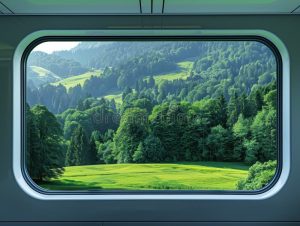
But it’s not just about carbon math. Slow travel by train reshapes your relationship with distance. You feel the landscape shift — the plains giving way to foothills, the foothills to mountains. You notice the small towns, the backyards, the rivers you’d otherwise fly right over. It’s travel as a sensory experience, not just a transaction.
The Case for Slowing Down (Yes, Really)
We’re conditioned to optimize. Fastest route, shortest layover, earliest arrival. But cross-country train journeys ask you to flip that script. A trip that takes three hours by plane might take two or three days by rail. And that’s… kind of the point.
Those extra hours aren’t wasted. They’re where the trip actually lives. You read. You nap. You strike up a conversation with a stranger who’s heading home to see their grandkids. You watch a thunderstorm roll across Kansas from the comfort of a lounge car. Try doing that at 35,000 feet.
Slow travel also tends to be cheaper, especially if you book sleeper accommodations early or pack your own snacks. And it opens up routes that airlines abandoned decades ago — small cities, rural stops, places that don’t even have an airport.
Choosing Your Route: What to Know Before You Book
Not all train journeys are created equal. Some are utilitarian commuter lines; others are rolling landmarks. If you’re going cross-country, you’ll want to think about scenery, schedule, and comfort level.
In the U.S., Amtrak’s long-distance routes are the main game in town. The California Zephyr, for example, cuts from Chicago to the Bay Area through the Rockies — arguably one of the most stunning rail corridors on the planet. The Empire Builder runs from Chicago to the Pacific Northwest, tracing the northern tier. The Southwest Chief hugs the old Santa Fe Trail through deserts and pueblos.
In Europe, the options multiply. Night trains are making a comeback — think Vienna to Venice, Berlin to Stockholm. And in places like Japan, India, and Canada, rail networks are practically woven into the national identity.
Here’s a quick comparison to help you think through the trade-offs:
| Factor | Train | Plane |
|---|---|---|
| CO2 emissions (per passenger) | Low to very low | High |
| Travel time (cross-country) | 2–4 days | 5–8 hours |
| Scenery | Continuous, immersive | Clouds, maybe |
| Luggage limits | Generous | Restrictive |
| Cost (flexible dates) | Often cheaper | Variable, often pricier |
That said, train travel isn’t perfect. Delays happen. Sleeper cars sell out. And some routes only run a few times a week. Planning ahead is your friend.
Practical Tips for a Smooth (and Green) Ride
Alright, let’s get into the nitty-gritty. Because a cross-country train trip can be blissful — or mildly chaotic — depending on how you prepare.
- Book early, especially for sleepers. Roomettes and bedrooms on popular routes vanish months in advance. If you’re flexible, off-season travel (late fall, early spring) means fewer crowds and lower fares.
- Pack light but smart. Bring layers, a refillable water bottle, snacks, and entertainment. Wi-Fi can be spotty, so download podcasts, books, or movies ahead of time.
- Choose your seat wisely. On many routes, the left side vs. right side makes a big difference in scenery. Do a quick search for “best side” on your specific route.
- Use the lounge car. It’s where the magic happens — panoramic windows, card games, and conversations with fellow travelers.
- Offset what you can’t avoid. Even trains have an impact. If you’re combining rail with a short flight or a rental car, consider a reputable carbon offset program.
And hey, don’t overthink it. Sometimes the best moments come from the unplanned stuff — a spontaneous stop in a town you’d never heard of, or a sunset that makes you forget to check your phone.
The Emotional Payoff of Going Slow
There’s a reason people wax poetic about train travel. It’s not just the emissions savings or the convenience. It’s the pace. The rhythm. The way a long ride gives your mind permission to wander.
In a world that’s constantly screaming “faster, faster,” choosing slow travel by train is a quiet act of rebellion. It says: I don’t need to be there yet. I’m already here. And that, honestly, might be the most eco-conscious mindset of all — one that values presence over productivity, connection over speed.
So if you’ve been itching to see more of the country without the guilt of a hefty carbon footprint, maybe it’s time to look at a rail map. Pick a route. Pack a bag. And let the tracks do the rest.